Make a lesson series
The lesson series your child needs doesn't exist. Make it.
Describe it in a conversation — what to cover, how deep, what to hook it on — and approve the outline. JoySchooler turns it into a real series of lessons, each taught through one-on-one Socratic dialogue that never just hands over the answer.
How it works
A conversation in. A series out.
1
Describe it
A conversation, not a form. The grade, the goal, what to include, what to skip, what they already know — and what they love, so the examples land. A draft outline appears right in the chat: three to fifteen lessons, one big idea each.
2
Shape it until it's right
The outline is a draft, not a verdict. Swap a lesson, slow down the hard part, insist every example involves horses. Nothing is built until you say so — the series that gets made is the one you approved.
3
A tutor teaches it
Each lesson is a live Socratic conversation with interactive materials built just for it. The first lesson is ready minutes after you approve; later lessons are built as your child reaches them, on top of what they actually understood.
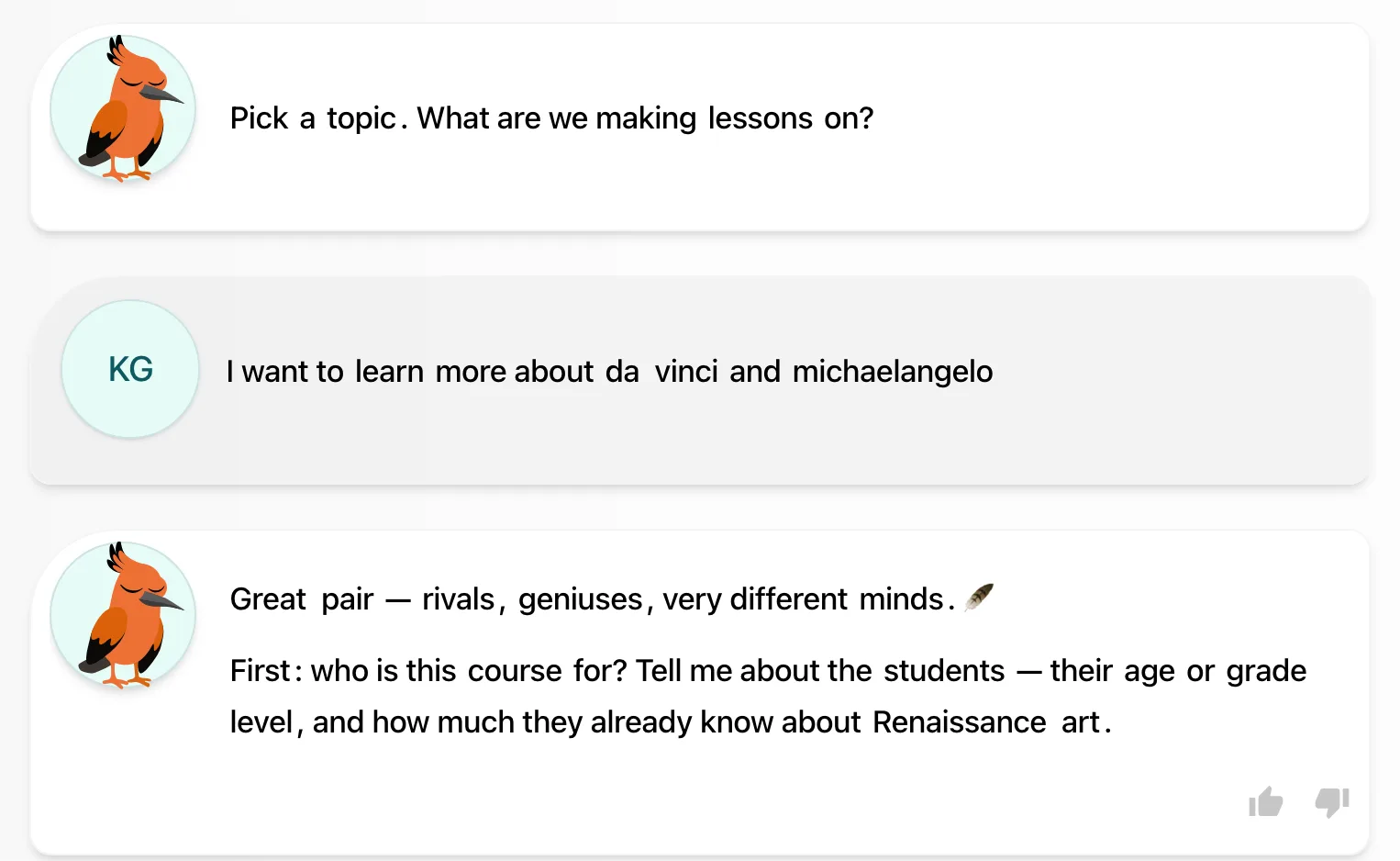
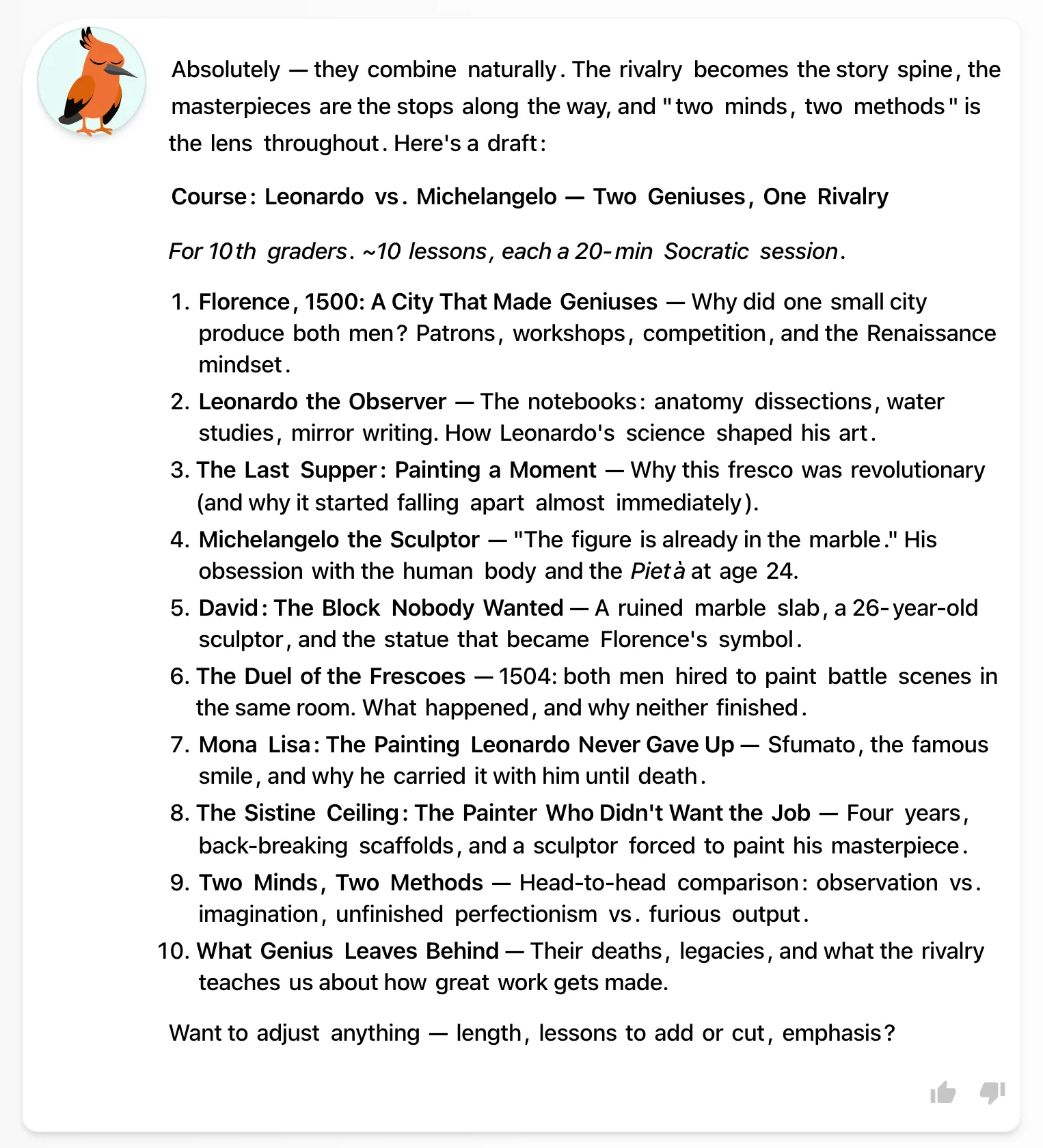
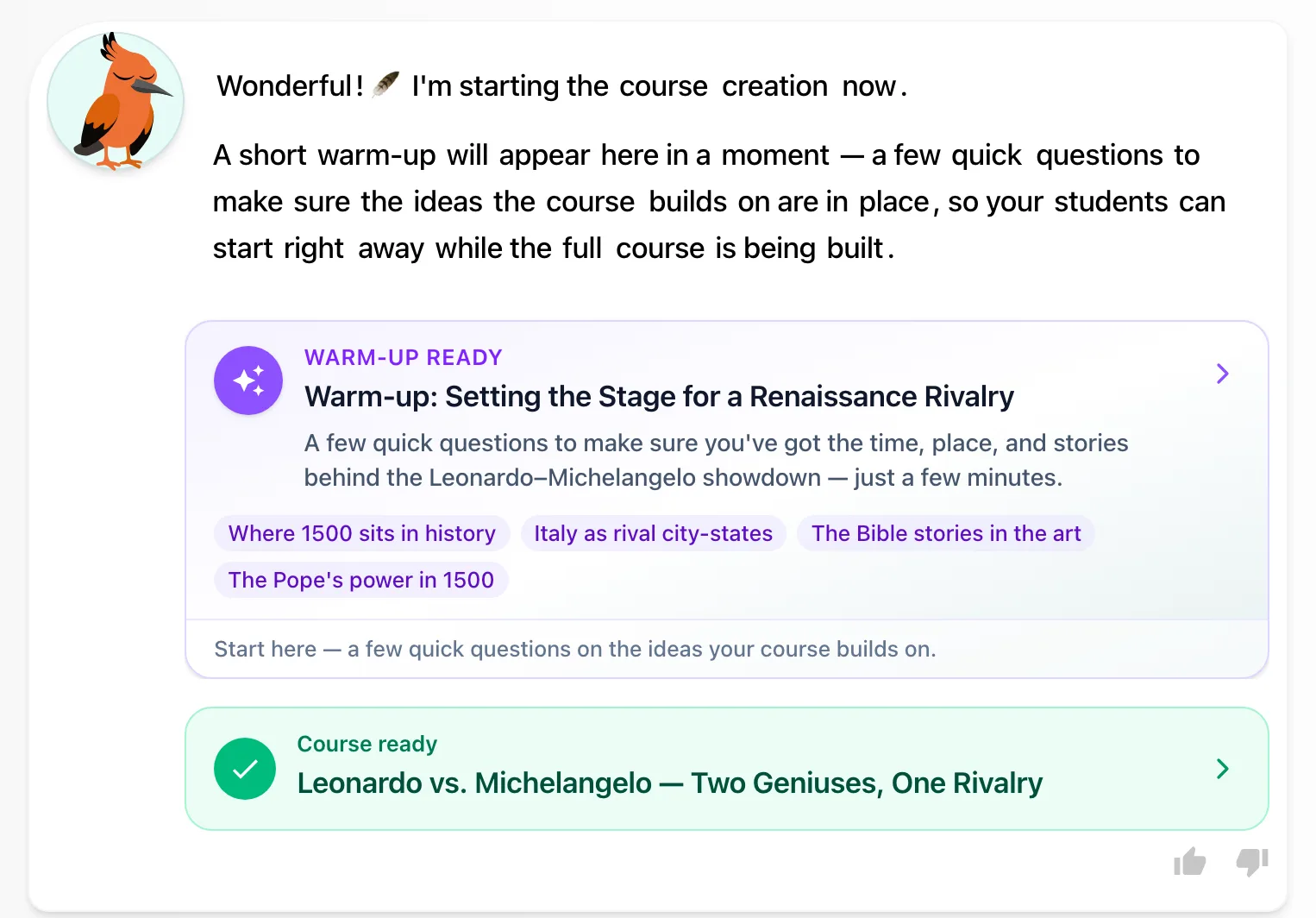
Here's a real one being made — from “I want to learn more about da Vinci and Michelangelo” to a ten-lesson series on the rivalry. The ask, the outline, and the moment the build starts:
Real scenarios
Made for moments like these.
Every series below starts the same way: a parent saying, in plain words, what their child actually needs. That sentence is the whole assignment.
The gap the report card names
“She's in grade 4 and fractions didn't stick — she still thinks 1/8 is bigger than 1/5, because 8 is bigger. She loves horses. Keep it gentle.”
A ten-lesson series that starts with sharing hay fairly between stalls, confronts that exact misconception head-on, and never states a rule she can't already picture.
The obsession school can't keep up with
“He's 7 and talks about volcanoes at every meal. I want the real science at his level — not cartoon facts.”
Nine lessons from “what's under your feet” to reading a real eruption map — a series that takes his questions as seriously as he does.
The book gathering dust on the shelf
“We bought him this astronomy book and he never got past chapter one. Turn it into a series. (attaches the book)”
Chapters become lessons, and each lesson is a conversation about what the chapter actually says. The book finally gets read — and argued with.
The subject school skips
“She's 13. Before anyone offers her a credit card, I want her to understand interest, debt, and why prices rise.”
A series on money that school won't teach for years, at exactly the depth you asked for — taught through questions, not lectures.
Ahead, and coasting
“He finished the unit early and he's bored. Don't accelerate him into next year's material — go deeper into the why of what he already knows.”
Depth instead of speed: why the division algorithm works, what makes a proof a proof. Stretch, without racing ahead of his class.
The homeschool unit, your way
“Twelve lessons on early American history built around primary sources and daily life — not battles and dates.”
Your sequence, your emphasis, your values — and every evening you can read exactly how the conversation went.
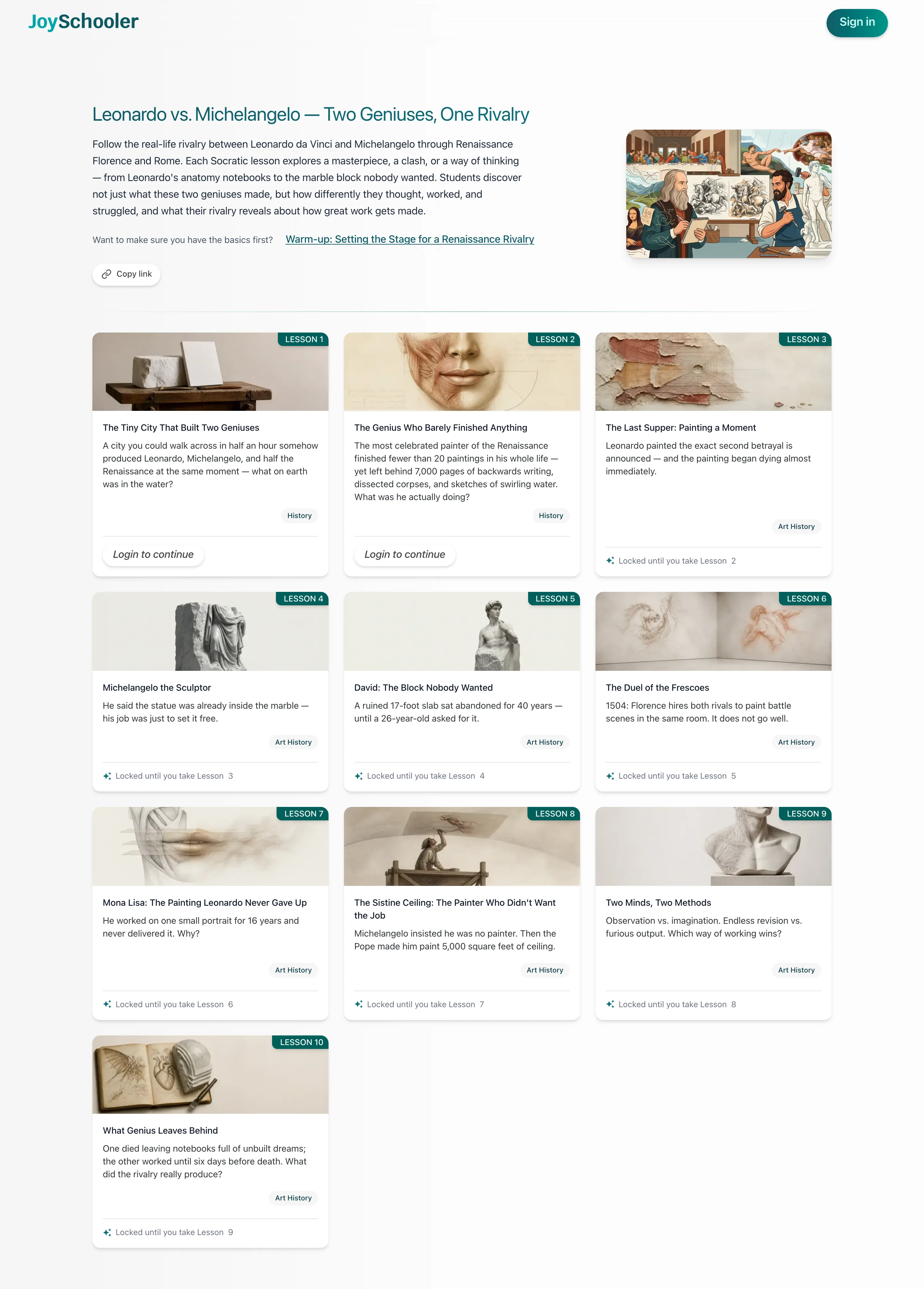
And this is what comes out the other side — the da Vinci and Michelangelo conversation above, as the series it became:
Your scope, your way
Be as specific as you want. It listens.
“A fractions series” works fine. But detail is honored: every lesson in the outline carries its own brief — the angle to take, the examples to use, the misconception to confront, where to stop — and the tutor teaches to that brief.
Scope
Cover this, skip that, stop before X. A huge topic becomes a sensible overview; a narrow one goes deep.
Depth and tone
The same topic built for a curious 7-year-old or a skeptical 14-year-old — you set the level, the pace, and how gentle it is.
The hook
Their obsession as the running example — horses, rockets, football — carried through every lesson, not pasted onto one.
Your materials
Attach a book and its chapters become the lessons. Attach videos and they get discussed, not just watched.
Change of plan
Any lesson your child hasn't reached yet is still a plan — reshape it in a quick chat and the series follows.
Grounded before it's built
At creation, every lesson gets a research pass — real facts and the documented misconceptions kids bring to that exact idea.
Inside a lesson
Not a video. Not a worksheet. A conversation.
Each lesson opens one big idea and works it Socratically: the tutor asks, listens, and nudges — with interactive materials built for that exact lesson. A diagram to manipulate, a chart to explore, a clip to discuss. Your child doesn't watch the idea; they reason their way into it.
And the series holds together like one story. The same terms, the same running examples, lesson five building on what your child actually worked through in lesson four — even when the lessons are weeks apart. Later lessons aren't pre-printed; each is built fresh when your child reaches it, on top of what they truly understood.

You stay close
You made it. You get to watch it work.
Send it like an assignment
Assign the series to your child and it lands in their work — with a due date if you want one. No printing, no setup, no nagging.
Progress you can trust
Progress is read from the conversations themselves — did the idea land, not did they click “done.” A child who's gone quiet for a week gets flagged; one who finished is left in peace.
Read the conversations
Every lesson's dialogue is there to open: where they struggled, what finally clicked, the question they asked that surprised you.
It starts where they are
Every series opens with a short warm-up over the ideas it assumes. If something's missing, it's taught on the spot — so lesson one never lands on thin ice.

See how assessment works — evidence, thinking moves, and misconceptions →
Share it — or keep it
Made for one child. Ready for thousands.
When you publish, your series joins the JoySchooler library under the author name you choose — your own, or a pen name. The series one report card made necessary might be exactly what another family is searching for tonight.
Signed your way
Published series carry the author name you picked — your real name, or a pen name you can change anytime. Only the series is shared: never the making conversation, never your child's progress.
Private when you want
Prefer to keep it in the family? Make any series private (on paid plans) or delete it entirely, whenever you like.
Kids create safely
A child account connected to yours can build series too. Theirs publish as “JoySchooler Learner” — never their name — are checked to keep personal details out, and you can always make them private or delete them, free.
Common questions
Making lesson series, answered.
Do I need to know the subject to make a good series?
No. You bring the goal and the child; the series maker asks the scoping questions, and each lesson is grounded in a research pass at creation. Plenty of parents build series on subjects they last saw in school — you're the editor, not the expert.
Is the content accurate?
Every lesson is researched when the series is created — including the documented misconceptions children bring to that exact concept, so lessons confront them instead of repeating them. You approve the outline before anything is built, and you can read every conversation after.
Will it just give my child the answers?
No — that's the core design. The tutor asks questions, offers hints, and waits. Your child does the reasoning, which is exactly why the understanding sticks.
How long does it take to create?
One conversation — usually a few minutes of describing and refining. The first lesson is ready minutes after you approve the outline; later lessons are built as your child reaches them, each shaped by what came before.
What ages and subjects does it work for?
Any subject you can describe — math, science, history, money, writing, or the thing your child won't stop asking about. You set the age, depth, and tone in the conversation, and the whole series is built to that level.
Can I change the series after it's made?
Yes. Any lesson your child hasn't taken yet can be reshaped through a short planning chat — add emphasis, swap examples, slow it down — and the lesson is built to the new plan.
Is what we make public?
Published series appear in the JoySchooler library under the author name you chose — your real name or a pen name. You can make any series private on a paid plan, or delete it anytime. The conversation you made it in and your child's progress are never shared.
Can my child build their own series?
Yes — a child account connected to yours can use the series maker too. Anything they publish is signed “JoySchooler Learner”, never their name, and is automatically checked to keep personal details out; if any are found, it stays private. You see everything they make, and either of you can make it private or delete it, free.
What does it cost?
The series maker is part of the family subscription, which covers your children's access too. See the pricing page for current details.
Get started
The series your child needs is one conversation away.
Also explore: How assessment works · Series for your class · AI for homeschoolers · A guide for parents