Make a lesson series
The unit you've always meant to teach. Built your way. Taught one-on-one.
Describe the unit — scope, sequence, depth, the misconception that survives every year — and approve the outline. JoySchooler builds it into a series of Socratic lessons, gives every student the one-on-one dialogue you can't multiply, and shows you understanding, not completion.
How it works
A planning conversation that ends in a series.
1
Scope it like a colleague
Tell it who it's for: the grade, the standards language, where the class actually is, what the textbook does badly. A draft outline lands in the chat — three to fifteen lessons, one major concept each.
2
The outline is your lesson brief
Every lesson description carries your angle, your examples, the misconception to confront, where to stop — and the built lesson follows that brief. Revise it in the chat until it reads like the unit in your head. Nothing is built until you approve.
3
Assign it, read the thinking
Hand it to the class or to named students. Each lesson meets every student as a one-on-one Socratic conversation, and your grid fills with understanding — not checkmarks — sorted by who needs you first.
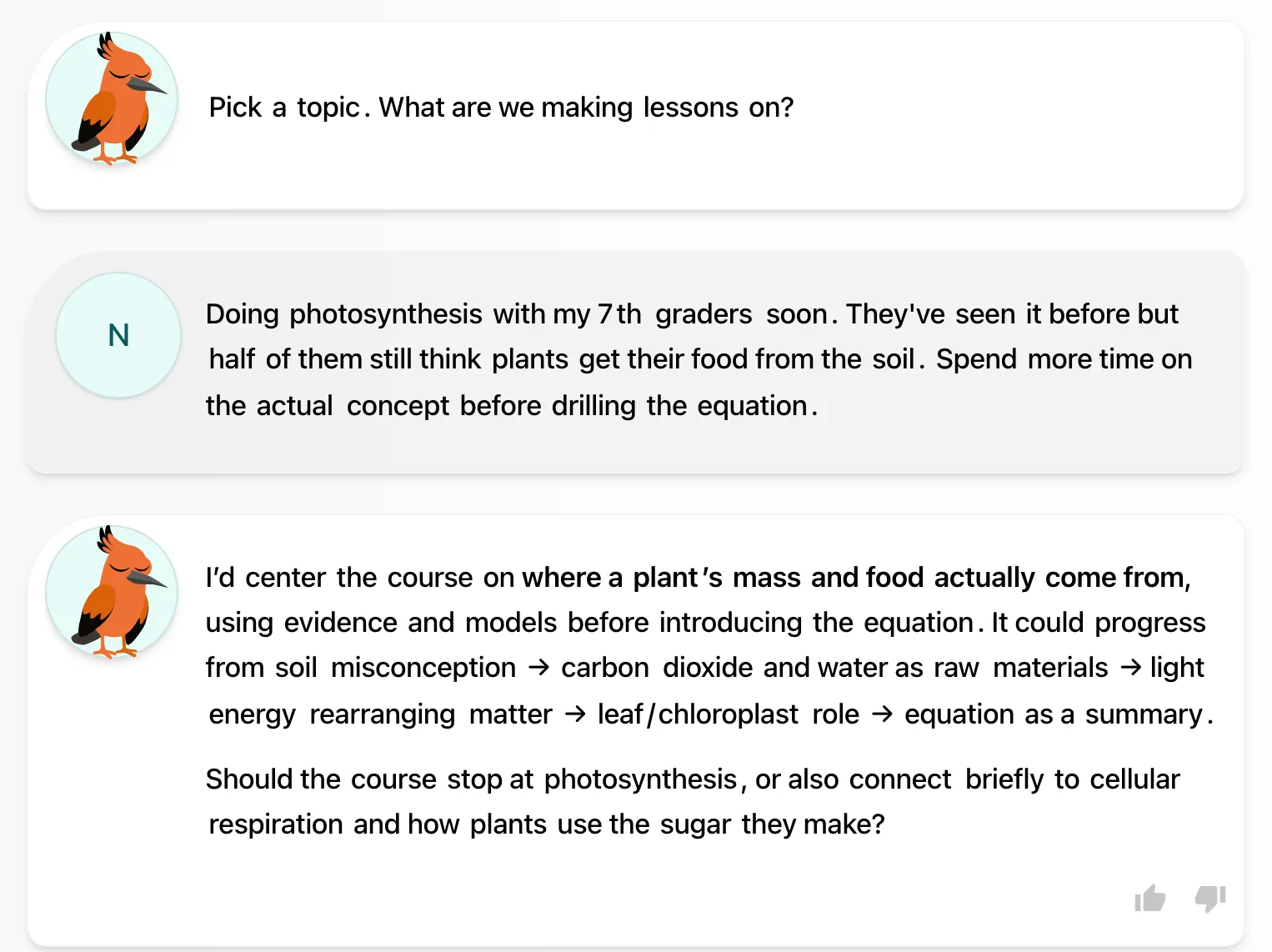
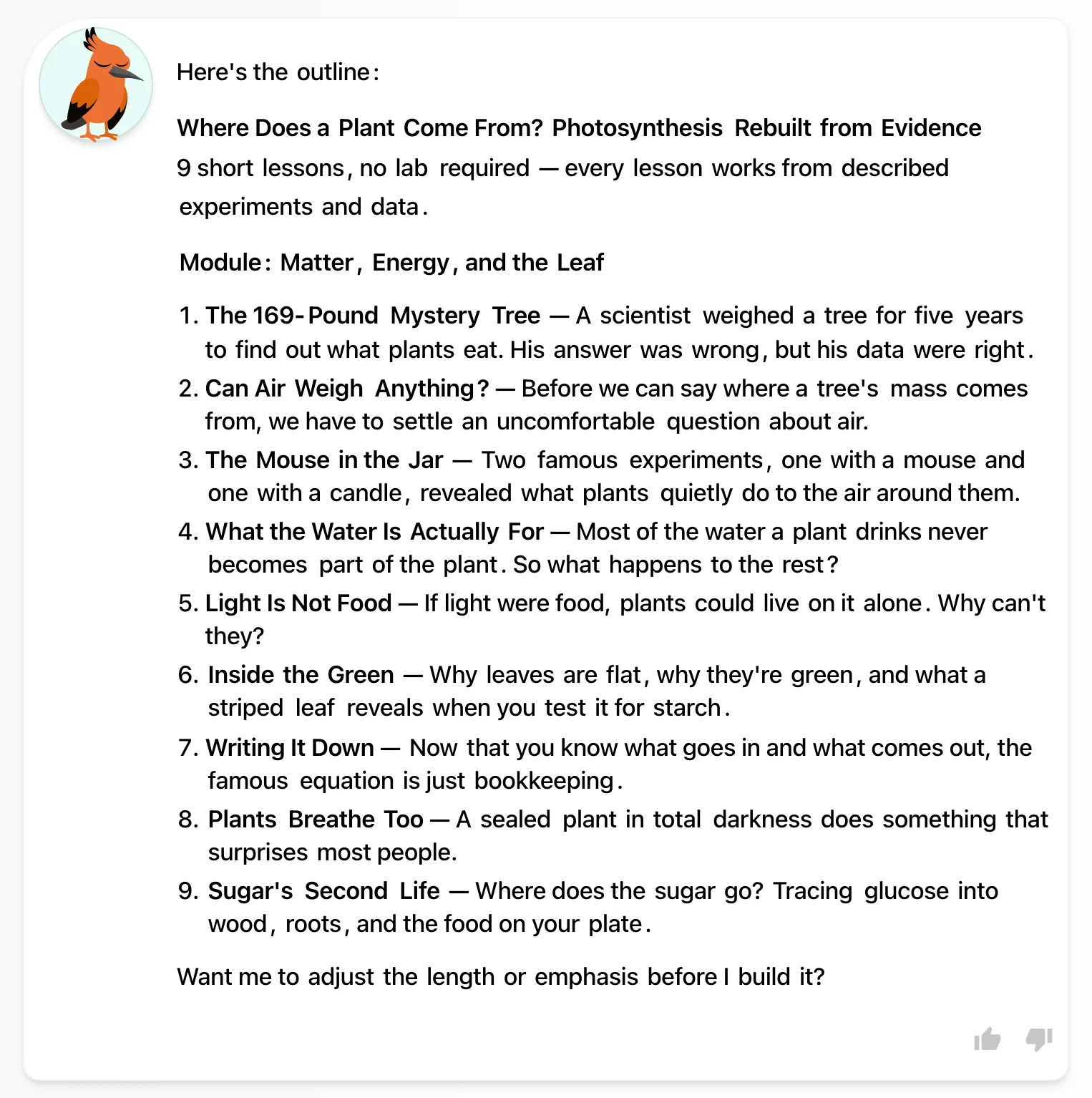
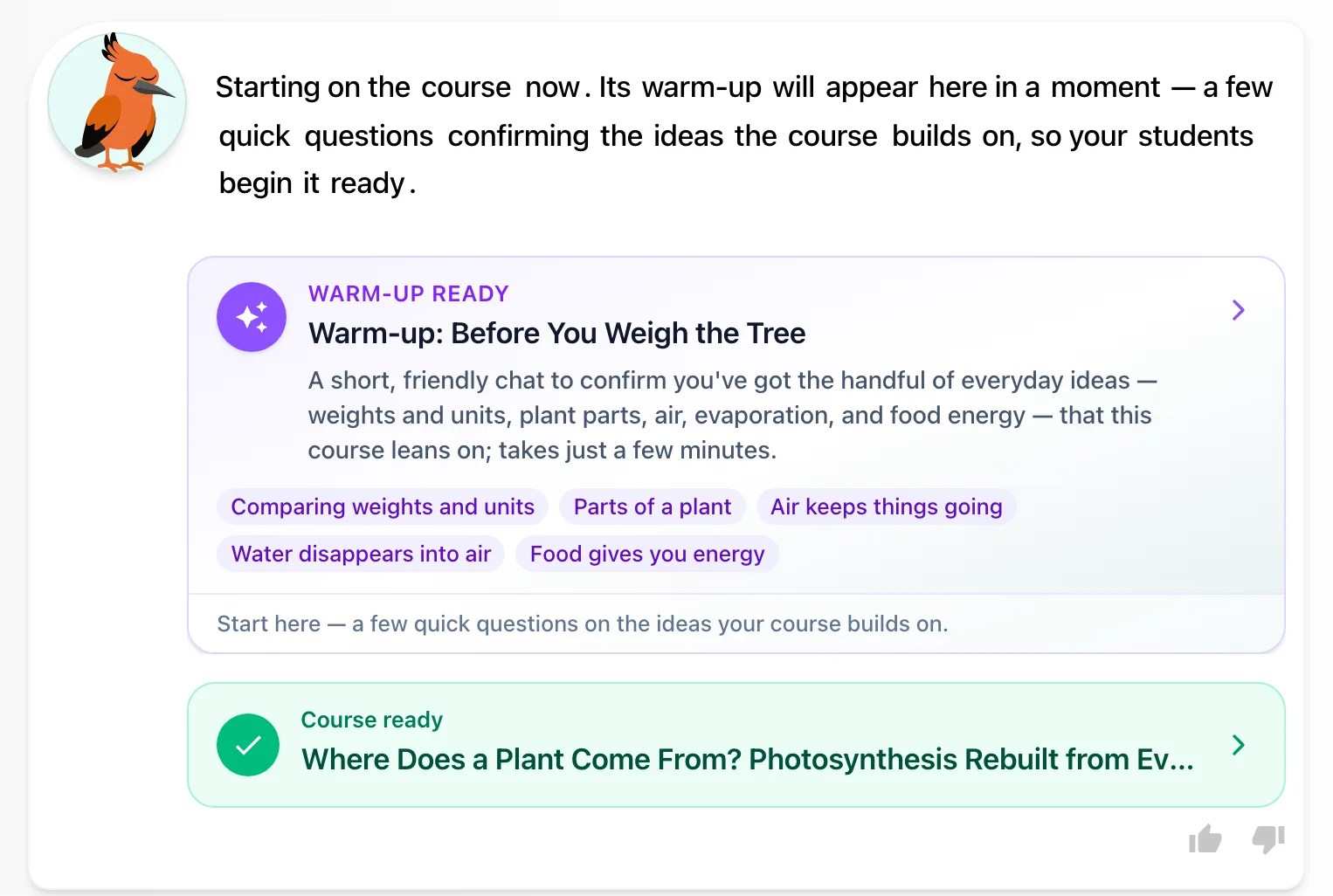
Here's a real unit being scoped — a teacher whose 7th graders still think plants eat soil. The ask, the nine-lesson outline it produced, and the moment the build starts:
Real scenarios
What teachers build with it.
Each of these starts as one paragraph said to the series maker — the kind of brief you'd give a very good student teacher. That brief is what gets built.
The unit the textbook teaches badly
“My 7th graders meet photosynthesis every year and still leave thinking plants eat soil. Start from “where does a tree's mass come from?”, sit with that for two lessons, and don't show the equation until lesson four.”
The sequence you always wanted taught, finally taught — because you dictated it. The misconception is confronted where it lives, not mentioned in a sidebar.
Three levels, one prep period
“Same fractions unit, three ways: heavily scaffolded for my intervention group, core for most of the class, extension with open problems for the four who finish everything.”
Three series, assigned to named students. Nobody is singled out — everyone is just doing “the fractions series.” Differentiation that doesn't cost a weekend.
The chapter, actually read
“Turn chapters 4–6 of our textbook into lessons. I want them discussing what the text says, not skimming it. (attaches the PDF)”
Chapters map to lessons, and every student walks the reading with a tutor that asks what the author meant — and won't accept a shrug.
The question that isn't in any curriculum
“My seniors keep asking about AI. Six lessons on how it actually works and how to judge what it tells you — no hype, no doom.”
Scoped on Monday, assigned by Friday. When the world hands your class a question, you don't have to wait for a textbook to exist.
The five who bombed the test
“Five students failed the decimals test the same way — here are the errors they actually made. Build six lessons that repair exactly this.”
A repair series for exactly those five, assigned only to them. The grid shows you the moment each one is ready to rejoin the class.
The week you're away
“I'm out all next week. The class should keep moving through the ecosystems unit — my sequencing, my emphasis, no busywork.”
The series carries the class while you're gone. Reading the conversations when you return tells you more about that week than any sub report ever has.
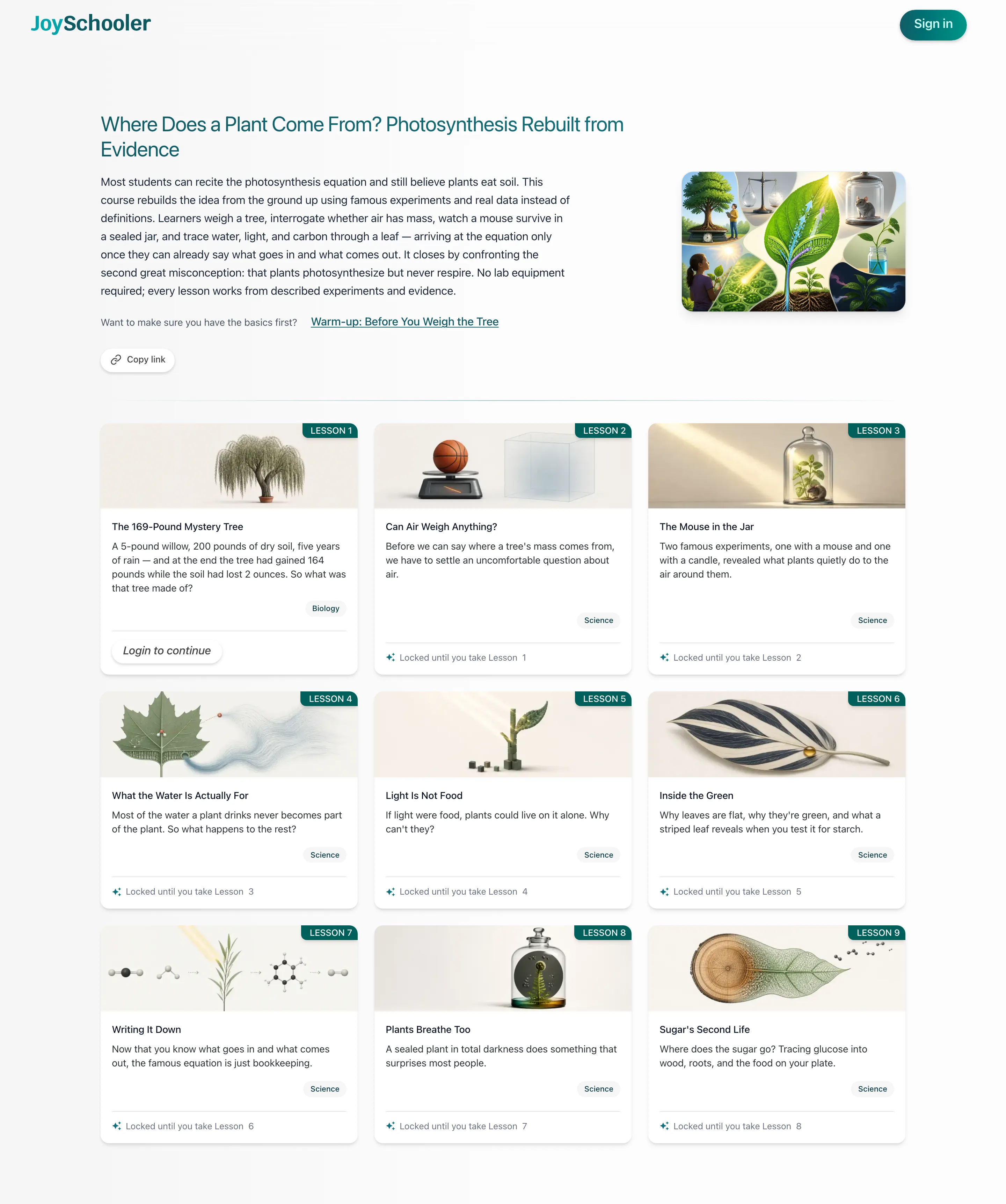
The photosynthesis brief from the first card is real — here it is as the unit it became: nine lessons rebuilding the idea from evidence, with the equation held back until it's just bookkeeping.
Authorship
Every decision stays yours.
This isn't a library of someone else's units. The outline is written with you, every lesson description is your brief — the angle, the examples, the misconception to confront, where to stop — and nothing is built until you approve. The richer your brief, the sharper the lesson: your expertise is the input.
Nothing builds without you
The outline is authored in the conversation, and the approved outline is the only thing the series is built from.
Grounded before it's built
At creation, every lesson gets a research pass — including the documented misconceptions students bring to that exact concept.
Steer mid-unit
Lessons the class hasn't reached are still plans. After you see how lessons one to three landed, reshape lesson four in a short chat.
A living sequence
Later lessons are built when the class reaches them, on top of what earlier lessons actually taught — no re-teaching, no drift.
One thread throughout
The series keeps a spine: consistent terminology, running examples, each lesson answering to the same big question — even weeks apart.
Your materials, taught
Attach the textbook and chapters become lessons. Attach videos and they're discussed Socratically, not just assigned.
What every student gets
The conversation you can't multiply.
You can't hold twenty-eight one-on-one dialogues at once. Your series can. Every lesson meets each student as a patient Socratic conversation at their pace — asking before telling, waiting out the silence, refusing to hand over the answer — with interactive materials built for that exact lesson.
And every series opens with a short warm-up over the ideas it assumes — a pre-assessment that wrote itself. By the first real lesson, gaps have been caught and patched, and you know who arrived missing what.

What you see
One glance, Monday morning.
Assign the series to the class — or to named students — and the progress grid shows every learner against every lesson, shaded by understanding. Not self-reported completion: understanding, read from the dialogue itself. The grid sorts by who needs attention first, flags anyone quiet for a week, and never nags a student who finished.
Any cell opens the actual conversation — where they hesitated, what they tried, the moment it clicked. It's the difference between a gradebook and sitting beside them.
See how assessment works — evidence, thinking moves, and misconceptions →

Beyond your classroom
The unit that finally works deserves an audience.
Publish a series and it joins the JoySchooler library under the author name you choose — your own, or a pen name — where other teachers and families can put it to work. Prefer to keep it to your own classes? Make any series private (on paid plans), or delete it anytime.
Either way, what's shared is only the lessons themselves. Your students' conversations, names, and progress never leave your class — as a creator you only ever see aggregate numbers, like how many learners started or finished.
Common questions
Building your own series, answered.
How is this different from a lesson library?
A library hands you someone else's unit and asks you to adapt around it. This builds yours: your scope, your sequence, your examples, your emphasis — then teaches it to every student one-on-one. The unit in your head is the product.
Where does the content come from — can I trust it?
From your approved outline, grounded by a research pass at creation that includes the documented misconceptions for each concept. You review the outline before anything is built, and you can read every student conversation after. Nothing teaches your class that you haven't seen the plan for.
Can students game it or copy answers?
The lesson is a Socratic dialogue — the tutor asks, probes, and follows up, and refuses to hand over answers. The artifact you assess is the reasoning itself, and reasoning can't be pasted in.
Does it fit my standards and curriculum?
You state the scope in your own words — standards language included — and the outline follows it. It works as a full unit, a parallel track for intervention or extension, or a supplement beside whatever you already teach.
How long does it take to build a unit?
About one planning-period conversation. The first lesson is ready minutes after you approve the outline; the rest are built as students reach them, each informed by what the previous lessons actually covered.
Can I change the series after assigning it?
Yes. Any lesson students haven't reached is still a plan — reshape it in a short chat and it's built to the new brief. Un-assigning a series never deletes student work.
Does publishing share anything about my students?
No. Publishing shares only the series itself — the lessons. Your students' conversations, names, and progress never leave your class, and creators only ever see aggregate numbers like how many learners started or finished.
Do I have to publish what I build?
Published series appear in the JoySchooler library under the author name you choose — a pen name works fine. On paid plans you can make any series private to keep it for your own classes, and you can delete a series whenever you like.
What does it cost for teachers and schools?
JoySchooler has plans for individual educators as well as schools and institutions, and a school subscription covers your students. See the pricing page for current details.
Get started
Your next unit is one conversation away.
Also explore: How assessment works · Series for your child · AI for teachers · The AI writing guide